
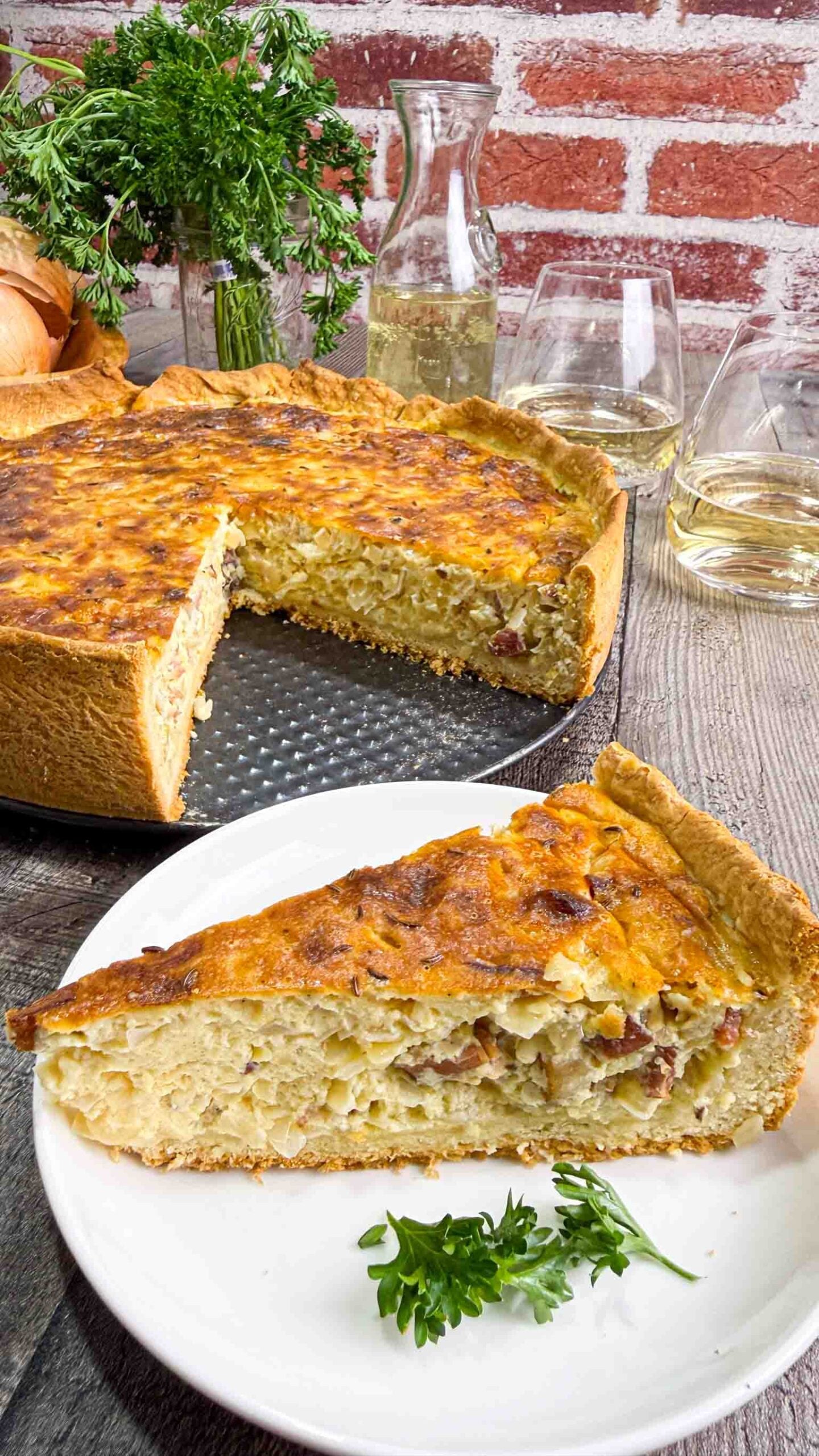
Zwiebelkuchen (German Onion Pie)

This post may contain affiliate links. Please see my Disclosure, Privacy and Terms of Use for more information.
If you’ve never had Zwiebelkuchen, let me paint you a picture. A soft, buttery yeast crust. A mountain of onions cooked low and slow until they turn sweet and golden. Smoky bits of bacon. And a creamy sour cream custard holding it all together with just a whisper of caraway. It’s like quiche’s cozy German cousin, the one who shows up in a wool sweater and brings the good stuff.
Don’t let the pile of onions scare you. Once they’re caramelized, they lose all their bite and turn mellow and almost jammy. This is the dish that makes onion skeptics go back for a second slice. I’ve seen it happen more than once.
Why You’ll Love This Recipe
This is one of those recipes that looks fancy on the table but is really just a handful of everyday ingredients and a little patience. Here’s why it keeps earning a spot in my fall baking rotation:
- It’s pure comfort food. Sweet onions, smoky bacon, and a creamy filling. Enough said.
- It works warm or cold. Serve it fresh out of the oven or pack a slice for lunch the next day. It’s delicious either way.
- It feeds a crowd. One 10-inch pie gives you plenty of generous slices for family or friends.
- You can take a shortcut. Not in the mood for yeast dough? A pie crust works too, and I’ll show you how.
- It’s a true German classic. This is the real deal, made the way it’s been made for generations, just adapted for an American kitchen.
A Little Note From Me

When the leaves start turning in Stuttgart, Zwiebelkuchen shows up everywhere: bakery windows, wine festivals, and pretty much every kitchen on the block. And it always comes with a glass of Federweißer, a young, cloudy, slightly fizzy new wine that’s only around for a few weeks in the fall. The salty, savory onion pie and the sweet, bubbly wine are a match made in heaven.
My favorite memory is sitting with Manny at one of those fall festivals, squeezed onto the long wooden benches and tables you find at just about every fairground, beer tent, and outdoor festival in Germany. We’d grab one of the very first Zwiebelkuchens of the season, still warm, with a glass of new wine on the side. The air smelled like fresh onion pie and young wine, and honestly, it’s something you have to experience for yourself at least once.

Every time I make this recipe in my own kitchen, those memories come right back. The smell of onions and butter slowly cooking in a big pan still tells me fall has officially arrived, and I feel a little bit homesick in the very best way.

What Is Zwiebelkuchen?
“Zwiebel” means onion and “Kuchen” means cake, so yes, the name literally translates to “onion cake.” Don’t worry, there’s no frosting involved.
Zwiebelkuchen is a savory onion tart from southwestern Germany, especially Swabia and the Palatinate region. It’s traditionally a fall dish, made when the new onion harvest comes in and the grape harvest is being turned into wine. Some families bake it in a big sheet pan and cut it into squares, while others (like this recipe) bake it in a springform pan for tall, pretty slices.
The easiest way to describe it to an American friend? Think quiche, but with way more onions, a yeast crust instead of pastry, and a creamy sour cream filling instead of heavy cream.
Ingredients You’ll Need
For the yeast crust:
- All-purpose flour and salt: The base of a soft, slightly bready crust.
- Active dry yeast and sugar: The sugar gives the yeast a little snack to help it get going. Instant yeast works too. Just mix it right into the flour.
- Milk: Use lukewarm milk, about as warm as a baby’s bath. Too hot and it will kill the yeast.
- Butter: Melted and cooled so it doesn’t cook the yeast.
For the filling:
- Yellow onions: The star of the show. You need about 2 ¼ pounds, which looks like a crazy amount, but they cook way down.
- Thick-cut bacon: Adds smoky, salty flavor. Thick-cut stays nice and meaty.
- Full-fat sour cream: Makes the custard rich and tangy. Skip the low-fat kind here; it can turn watery.
- Eggs and flour: They set the filling so it slices cleanly.
- Caraway seeds: This is the classic German touch. If you’ve had rye bread, you know the flavor.
Don’t skip it! - Salt and black pepper: To bring everything together.
How to Make Zwiebelkuchen
This recipe has three simple parts: make the dough, cook the onions, then put it all together and bake. The onions can cook while the dough rises, so the timing works out nicely.
Step 1: Wake up the yeast. Stir the yeast and sugar into the lukewarm milk. Let it sit for about 5 minutes until it looks a little foamy.
Step 2: Make the dough. Add the flour and salt to your stand mixer bowl and make a little hole in the middle. Pour in the melted butter and the yeast mixture. Knead with the dough hook for about 6 minutes, until the dough is smooth and soft. If it’s too sticky, add a spoonful of flour. If it’s too dry, add a splash of milk.
Step 3: Let it rise. Shape the dough into a ball, lightly grease the bowl, and put the dough back in. Cover it loosely and let it rise somewhere warm for about an hour, until it’s almost doubled.
My warm-spot trick: Turn your oven on to 350°F for just 1 minute, then turn it off. Pop the bowl inside. It’s the perfect cozy spot for dough.
Step 4: Cook the bacon. While the dough rises, cook the diced bacon in a large pan until it’s nicely browned.
Step 5: Caramelize the onions. Add the diced onions and the 2 tablespoons of butter right into the pan with the bacon. Turn the heat down to medium-low and let them cook slowly, stirring now and then, for 30 to 40 minutes. You want them soft and golden brown. Take the pan off the heat and let it cool.
Step 6: Mix the filling. In a big bowl, whisk together the sour cream, eggs, flour, salt, caraway seeds, and a few good grinds of black pepper. Stir in the cooled onion and bacon mixture until everything is well mixed.
Step 7: Heat the oven. Preheat your oven to 400°F.
Step 8: Shape the crust. Butter a 10-inch springform pan. Roll the dough into a circle about 1/8 to 1/4 inch thick. Lay it in the pan and press it across the bottom and up the sides, stopping about ½ inch from the top. Trim off any extra.
Step 9: Fill it up. Pour the filling into the crust right away. The dough likes to shrink back, but the heavy filling holds it in place. Sprinkle a few extra caraway seeds on top.
Step 10: Bake. Bake on the middle rack for 55 to 60 minutes. It’s done when the top is lightly browned and the center feels mostly firm when you gently press it.
Step 11: Let it rest. Let it cool for at least 20 minutes before you release the springform and slice it. This helps the filling set so you get clean slices.
Equipment You’ll Need
- 10-inch springform pan
- Stand mixer with dough hook
- Large skillet or sauté pan
- Large mixing bowl
- Whisk
- Rolling pin
- Cutting board and sharp knife
💡 Debbie’s Tip
Low and slow is the secret. I know it’s tempting to crank up the heat to speed up the onions. Please don’t! High heat burns the outside before the inside turns sweet, and you’ll end up with bitter, crunchy onions. Put on a podcast, give them a stir every few minutes, and let them take their time. It’s worth it, I promise.
Save your tears: Chill your onions in the fridge for 30 minutes before chopping them. Cold onions make you cry a lot less. A food processor also works great for dicing this many onions. Just pulse them so they don’t turn to mush.
Variations & Substitutions
This recipe is pretty flexible. Here are a few easy ways to switch it up based on what you have or who you’re feeding:
- Use pie crust instead: Skip the yeast dough and use half a batch of your favorite homemade pie crust (or a store-bought one). Grease the springform, press the crust in, leave about ½ inch at the top, and fill.
- Make it vegetarian: Leave out the bacon and cook the onions in 3 to 4 tablespoons of butter. A pinch of smoked paprika adds back a little of that smoky flavor.
- Sheet pan style: Double the recipe and bake it on a rimmed baking sheet, the way many German bakeries do. Cut into squares for a party. Start checking it a bit earlier since it’s thinner.
- Swap the sour cream: Crème fraîche works beautifully if you have it.
- No caraway fans? You can leave it out, but it won’t taste quite as German. Try using just half the amount first.
❄️ Storage & Freezing
Good news: Zwiebelkuchen keeps really well, and some people (me included) think it tastes even better the next day.
- Fridge: Cover leftovers and keep them in the fridge for up to 3 to 4 days.
- Reheat: Warm slices in a 350°F oven for about 10 to 15 minutes. The microwave works in a pinch, but the crust will get soft.
- Freeze: Let it cool completely, then wrap individual slices tightly in plastic wrap and foil. Freeze for up to 2 months. Thaw overnight in the fridge and reheat in the oven. Mine does not make it to the freezer!
⚠️ Important
Let the onions cool before mixing them into the filling. If they’re still hot, they can start cooking the eggs, and you’ll get little scrambled bits instead of a smooth custard. Give them 10 to 15 minutes off the heat first.
Frequently Asked Questions
Here are the questions I hear most about this German onion pie.
Can I make Zwiebelkuchen ahead of time?
Yes! Bake it a day ahead, chill it, and serve it cold or rewarmed. You can also caramelize the onions and bacon up to 2 days early and keep them in the fridge.
Why did my crust shrink down the sides?
Yeast dough is stretchy and likes to spring back. Work quickly and pour in the filling right after you shape it. The weight of the filling holds it in place.
Can I use red or sweet onions?
You can, but yellow onions give the classic flavor. Sweet onions work well too; they’ll just make the pie a little sweeter.
What do you serve with Zwiebelkuchen?
In Germany, it’s traditionally served with Federweißer (new wine). At home, it’s great with a simple green salad, a crisp apple cider, or a light white wine.
More Recipes You’ll Love
From My Kitchen to Yours
There’s something so comforting about a big, golden Zwiebelkuchen coming out of the oven, the whole house smelling like butter and onions. It’s simple, humble food, and that’s exactly what makes it so special. Cut yourself a warm slice, pour something nice to drink, and enjoy a little taste of fall in Germany.
And if you ever get the chance, go see it for yourself! Plan a trip to Stuttgart in the fall, when the big Cannstatter Wasen festival fills the city with music, long wooden tables, and happy crowds. Or better yet, wander out to the little towns and wine villages around Stuttgart, where the local wine festivals and cozy family-run “Besen” wine taverns serve warm Zwiebelkuchen with fresh Federweißer. Sitting shoulder to shoulder on those benches, sharing a table with people you just met, is something you’ll never forget.
Until then, this recipe is the next best thing. If you make it, I’d love to see it!
Enjoy every bite,


Zwiebelkuchen (German Onion Pie)
Ingredients
Yeast Crust
- 2 cups all-purpose flour
- 1 teaspoon salt
- 3 tablespoons butter melted and cooled
- ⅔ cup lukewarm milk
- 1 ¼ teaspoons active dry yeast or instant yeast
- 1 teaspoon sugar
- ½ batch pie crust optional alternative to yeast crust
Filling
- 5 slices thick-cut bacon finely diced
- 2 ¼ pounds yellow onions finely diced
- 2 tablespoons butter
- 1 ½ cups full-fat sour cream
- 4 large eggs
- 2 tablespoons all-purpose flour
- 2 teaspoons salt
- 1 teaspoon caraway seeds plus extra for sprinkling
- Freshly ground black pepper to taste
Instructions
- Activate the yeast. Stir the yeast and sugar into the lukewarm milk. Let it sit for 5 minutes, until the mixture begins to look foamy. If using instant yeast, you can skip this step and add the yeast directly to the flour.
- Make the dough. Add the flour and salt to the bowl of a stand mixer and make a well in the center. Pour in the melted and cooled butter and the yeast mixture. Using the dough hook, knead for about 6 minutes, until the dough is smooth, soft, and elastic. If the dough feels very sticky, add flour a tablespoon at a time. If it seems too dry, add a small splash of milk.
- Let the dough rise. Shape the dough into a ball and place it in a lightly greased bowl. Cover loosely and let rise in a warm place for about 1 hour, or until nearly doubled in size.
- Cook the bacon. While the dough is rising, add the finely diced bacon to a large skillet. Cook until the bacon is nicely browned.
- Cook the onions. Add the diced onions and 2 tablespoons butter to the skillet with the bacon. Reduce the heat to medium-low. Cook slowly for 30 to 40 minutes, stirring occasionally, until the onions are very soft and golden. Do not rush this step or use high heat. Remove the pan from the heat and allow the onion and bacon mixture to cool for 10 to 15 minutes.
- Make the filling. In a large bowl, whisk together the sour cream, eggs, flour, salt, caraway seeds, and freshly ground black pepper until smooth. Once the onion and bacon mixture has cooled, stir it into the sour cream mixture until evenly combined.
- Preheat the oven. Preheat the oven to 400°F.
- Shape the crust. Butter a 10-inch springform pan. Roll the risen dough into a circle approximately 1/8 to 1/4 inch thick. Carefully transfer it to the pan. Press the dough evenly across the bottom and up the sides, stopping about 1/2 inch below the top edge of the pan. Trim away any excess dough.
- Add the filling. Pour the onion filling into the prepared crust immediately. The weight of the filling will help keep the yeast dough from shrinking down the sides. Smooth the top and sprinkle with a few additional caraway seeds, if desired.
- Bake. Place the springform pan on the middle oven rack and bake for 55 to 60 minutes. The Zwiebelkuchen is ready when the top is lightly golden brown and the center feels mostly firm when gently pressed.
- Cool and serve. Remove from the oven and let the Zwiebelkuchen rest in the pan for at least 20 minutes. Carefully release the springform pan, then slice. Serve warm, lukewarm, or cold.