

I'll be honest with you — scones were not a thing in Germany. Not in my grandmother's kitchen, not in the bakeries where I trained, not anywhere. When I moved to Florida and encountered them for the first time, I wasn't quite sure what to make of them. Somewhere between a biscuit and a pastry, with fruit inside and icing on top? The whole concept was new to me.
So naturally, I made a batch. And then another. And now, more than three decades later, I make them at least twice a year — and they are gone by evening. Every single time. My family, who had also never heard of scones before I introduced them, now acts like they've been eating them their whole lives. That's the power of a really good scone.
If you've never made scones before, I promise they're more forgiving than they look. Here's why this recipe is going to become a regular in your kitchen too.
When I made scones for my family for the first time back in Florida, there was a lot of polite curiosity happening. My husband Manny picked one up, turned it over, studied it from a few angles. Kevin — who was a teenager at the time and deeply suspicious of anything unfamiliar — asked if it was a biscuit or a cake. Jennifer just went ahead and ate one and declared it good, which is honestly the most efficient approach.

By the end of that first plate, they were gone. Every one. And Kevin, who had asked so many questions about what he was even looking at, had eaten three. Some things transcend cultural food traditions, and apparently strawberry scones are one of them.
I've been making them at least twice a year with fresh strawberries ever since. They're best the day they're made — warm, with the icing still a little soft — and in all the years I've been baking them, I have never once had leftovers. Not a single crumb by evening.

For anyone who grew up in Germany (or anywhere scones aren't common), here's the quick version. Scones are a British baked good — a cross somewhere between a biscuit and a pastry, tender and slightly rich from butter and cream, with a golden crust on the outside. They're traditionally served at afternoon tea, though in my house they're served whenever I feel like making them, which is enough of an occasion.
The key to a good scone is cold butter and a light hand with the dough — the same principles I learned in German pastry training, just applied to a very different shape. Once you know the technique, scones are actually one of the easier things to pull off in a baking kitchen.
These are simple, everyday ingredients — but each one is doing something specific. Here's what you should know before you start.
⭐️ All-purpose flour — the backbone of the scone. Measure it correctly (spoon it into the cup, don't scoop) for the right texture.
⭐️ Sugar — just enough for a little sweetness without making these feel like dessert. Though honestly, the icing handles the dessert part.
⭐️ Baking powder — the full tablespoon is intentional. This is what gives the scones their rise and that slightly craggy top.
⭐️ Salt — don't skip it. It balances the sweetness and brings out the strawberry flavor.
⭐️ Very cold butter — this is the most important ingredient on the list. Cold butter creates steam pockets as it bakes, which is what makes scones tender and flaky rather than dense. If your kitchen is warm, pop the butter in the freezer for 10 minutes before you start.
⭐️Fresh strawberries — diced small so you get berry in every bite without making the dough too wet. Toss them in the flour mixture to coat them — this helps them stay suspended in the dough rather than sinking. Got a bumper crop? Check out my Do It Right: How to Freeze Strawberries guide so you always have some on hand.
⭐️ Eggs — give the scones structure and richness.
⭐️ Half and half — the fat content here matters for texture. Don't swap for regular milk if you can avoid it.
⭐️ Vanilla extract — in both the dough and the icing, because vanilla and strawberry are a team.
⭐️ Powdered sugar — for the drizzle. Simple, fast, and exactly the right finishing touch.
Nothing you don't already have, most likely — but a couple of these do make a real difference.
 Mixing Bowl Set Spatula Set
Take it one step at a time and don't overwork the dough — that's really the only rule that matters here.
Whisk together: In a large bowl, whisk together the flour, sugar, baking powder, and salt until well combined.
Break up butter: Add the very cold butter, cut into small cubes. Use a pastry cutter or your fingertips to break it into the flour mixture until it resembles coarse crumbs with some pea-sized pieces still visible. Work quickly — you want the butter to stay cold.
Strawberries: Add the diced strawberries and toss gently to coat them in the flour mixture.
Whisk together: In a separate bowl, whisk together the eggs, half and half, and vanilla extract.
Combine: Pour the egg mixture into the flour mixture and fold gently with a spatula just until the dough comes together. It will look shaggy and a little rough — that's perfect. Do not overmix.
Bring it together: Turn the dough out onto a lightly floured surface and gently bring it together into a ball. Divide the dough in half.
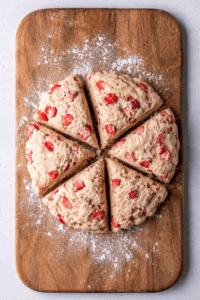
Cut in half: Shape each half into a ball, then flatten gently into a round disc about 1 inch thick. Cut each disc into 6 equal wedges, like a pizza.
Freeze: Place the wedges on a parchment-lined baking sheet and transfer to the freezer for 20 minutes. This step is key — it firms the butter back up and helps the scones hold their shape.
Preheat your oven to 375°F while the scones chill.
Bake for 16 to 18 minutes, until the tops are golden and the edges look set.
Mix glaze: While the scones cool, whisk together the powdered sugar, half and half, and vanilla extract until smooth. Drizzle over the cooled scones and let the icing set for a few minutes before serving.

These are the things I've learned from making scones more times than I can count — the details that separate a good scone from a great one.
Once you have the base recipe down, there are so many directions you can take it.

I'll keep this section short because, honestly, storage has never been an issue in my house — these are gone by evening.
Best eaten the day they're made, warm or at room temperature, with the icing still a little soft.
If you do have leftovers (rare, but possible), store in an airtight container at room temperature for up to 2 days. A quick 10-second zap in the microwave brings them back nicely.
To freeze unbaked scones: freeze the cut wedges on the baking sheet before baking, then transfer to a freezer bag once solid. Bake from frozen at 375°F, adding about 5 extra minutes to the bake time.
 Why do you put the scones in the freezer before baking?
The 20-minute freezer rest firms the butter back up after all that handling, which is what gives you tall, flaky scones with good structure. It's the same principle as chilling pie dough — cold fat equals better texture.
 Can I use frozen strawberries instead of fresh?
Fresh is strongly recommended here. Frozen strawberries release a lot of moisture as they thaw, which can make the dough too wet and the scones soggy. If fresh aren't available, thaw, drain, and pat them very dry first.
 Why do I toss the strawberries in the flour mixture?
It helps the berries stay evenly distributed through the dough rather than sinking to the bottom, and it absorbs some of the berry moisture so the dough doesn't get too wet.
 My scones came out dense. What happened?
Most likely the butter was too warm, the dough was overmixed, or both. Keep everything cold and fold gently — less is more when it comes to scone dough.
 Can I make the dough ahead of time?
Yes! You can shape and cut the scones, then keep them covered in the fridge overnight. Bake straight from the fridge the next morning — no freezer step needed since they've already chilled.
 Can I make these without the icing?
Absolutely — they're delicious plain, and honestly that just makes them more appropriate for breakfast rather than dessert. Or both. No judgment here.
Scones are one of those things that work at almost any time of day, which is part of why I love them so much.
These strawberry scones have made believers out of everyone in my family — including the ones who didn't know what a scone was until I handed them one. If you make them, eat them fresh, eat them warm, and don't plan on having any left by morning. If you want to see the whole process, including the butter-cutting technique that makes all the difference, the video is up on the YouTube channel.
Enjoy every bite,
Debbie
These Easy Strawberry Scones with Vanilla Glaze are buttery, flaky, and filled with fresh strawberries. Baked until golden and finished with a sweet vanilla glaze, they’re perfect for breakfast, brunch, or an afternoon treat.


